As the clock ticks down to the threshold of a New Year, the tradition of making resolutions often takes center stage. Have you ever paused to ponder the ancient origins of this practice and how it has evolved through the centuries? Did you know it originated in promises made to ancient gods?
I went on a brief journey of exploration and learned a few interesting things about the origin of New Year's resolutions, from the sacred promises made to ancient gods during the Akitu festival to merging into Christendom under the influence of Protestant traditions, with some surprising links to the modern pursuit of self-improvement.
New Year's resolutions are not a new tradition. The earliest recorded New Year's resolutions were made by the ancient Babylonians around 4,000 years ago. They celebrated the New Year with a 12-day festival called Akitu around 2000 B.C. This festival marked the beginning of the farming season and involved crowning the king and making promises to pay debts, and making promises to the gods in hopes of receiving good fortune in the coming year. One common resolution among the Babylonians was to return borrowed farm equipment. Their New Year began in mid-March, the start of the farming season, so this resolution was important in an agriculturally-based society. They could incur the favour of the gods if they kept their promises.
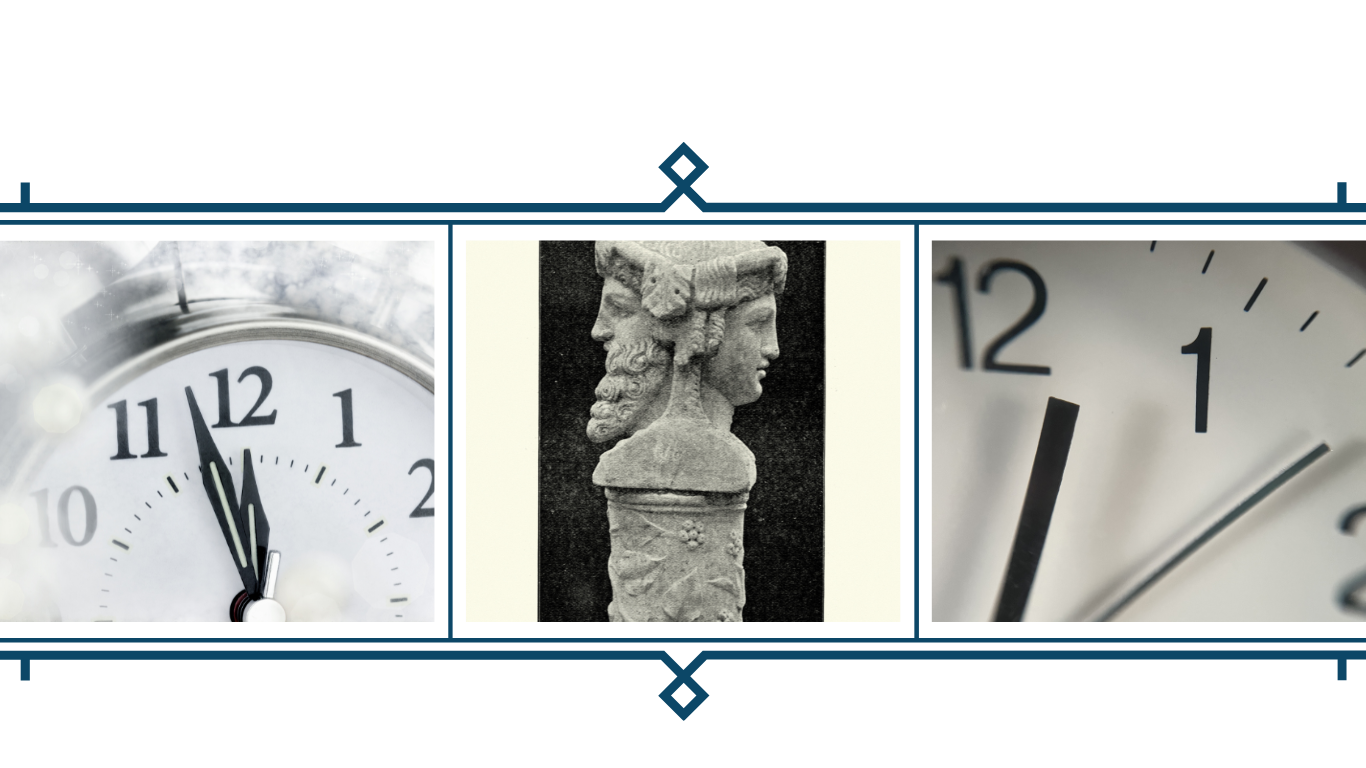
The Romans adopted the New Year tradition but changed the timing to January, with the new Julian calendar being initiated in 46 B.C. January was named for the two-faced god Janus, who looked forward to new beginnings as well as backward for reflection and resolution. The Romans gave sacrifices to Janus and made promises of new beginnings and better behaviour in the year ahead.
In the Middle Ages, in Medieval Europe, the practice of making resolutions found its way into Christianity, and the promises at the start of the year took on a moral and religious tone. People pledged to lead better lives, develop stronger moral character or work ethic, and exercise more restraint in the face of earthly temptations.
In contemporary times, the tradition continues in both secular and Christian practices. There has, however, been a shift to making resolutions around self-improvement with regard to personal habits, health and lifestyle changes.
Anna Almendrala, Huffington Post
"...the New Year’s resolution as a means of self-improvement may be a uniquely American tradition. And we may have one of the country's earliest religious traditions, Protestantism -- along with our colonial British legacy -- to thank.
The Influence of Protestantism on the Resolution
According to research done by Isidor Thorner, New Year's resolutions stem from the Protestant tradition of lifelong emotional discipline. Adherents of Ascetic Protestantism, while emphasizing hard work and denial of worldly pleasure and earthly indulgence, believed that material wealth and worldly success were signs of spiritual uprightness and God's favour.
New Year’s resolutions as a Christian practice might have originated from Watch Night New Year's Eve services popularized by the Methodist church in England in the 18th century at the time of John Wesley. The Methodist churches were strongly influenced by the Moravian Church and Radical Pietism in general. In the Moravian Church, congregations observe a three-hour watchnight service on New Year's Eve, which is preceded by the celebration of the lovefeast, dating back to at least 1733.
The Watch Night services were a way to ring in the New Year in a more spiritual, contemplative way, as opposed to raucous, all-night partying and "revelling." Watchnight services (also called Watchnight Mass) are late-night Christian church services that have become common in many Christian denominations.
The services were an opportunity for reflection on the past year and also became opportunities for spiritual resolutions of self-improvement for the coming year. It's interesting to note that only English-speaking, Protestant countries like Australia, England, Wales, Scotland, Northern Ireland, and South Africa have a strong tradition of making New Year’s Resolutions.
The Modern New Year's Resolution - Less Spiritual?
Fast forward to contemporary times: it used to be that people dedicated their lives to their conception of God, but now it's more common to make New Year's resolutions to lose weight and exercise regularly.
Looking back at past New Year's resolutions, it seems that Americans' top resolutions used to have a more "spiritual" quality than they do now. (Almendrala)
Resolutions For 1947 - Gallup Poll
1. Improve my disposition, be more understanding, control my temper
2. Improve my character, live a better life
3. Stop smoking, smoke less
4. Save more money
5. Stop drinking, drink less
6. Be more religious, go to church oftener
7. Be more efficient, do a better job
8. Take better care of my health
9. Take greater part in home life
10. Lose (or gain) weight
"The typically Protestant character of these resolutions is self-evident," says Thorner. (Cited by Almendrala, A., 2017)
Note that in 1947, some people actually resolved to gain weight. Compare the 1947 list to University of Scranton’s list for 2014, in which weight loss shoots to the top, and resolutions to strengthen one’s character or be more religious all but disappear.
We can see a shift in the nature of the resolutions in the 21st century, where they seem less "spiritual".
Resolutions For 2014
1. Lose weight
2. Getting organized
3. Spend less, save more
4. Enjoy life to the fullest
5. Stay fit and healthy
6. Learn something exciting
7. Quit smoking
8. Help others in their dreams
9. Fall in love
10. Spend more time with family
Sociologists suggest that people prioritize weight loss over other meaningful resolutions because it is associated with social status, moral virtue, and financial wealth. People diet for reasons like looking better, dealing with stigma, feeling normal, or making their children proud, rather than prioritizing health.
Having a slim and toned physique is often associated with high social status, as it requires significant investments in personal chefs, trainers, and gym memberships. This is why weight loss is a common New Year's resolution. However, some argue that modern priorities are sad and selfish, when, for example, they prioritize weight loss over more meaningful resolutions like give more to charity or being more involved in social causes and helping the needy, or being a better friend or parent.
However, medical sociologist Natalie Boero has argued that weight is actually tied up with all sorts of moral and spiritual issues in today's society. A trim figure is seen as a sign of goodness, responsibility, and self-discipline, which is not that far from how the New Year's resolution began in America. Dieting or physical transformation is often part of New Year's resolutions, and since the mid-twentieth century, weight and health have been associated with moral virtue.
According to medical sociologist Natalie Boero, when people are asked why they diet, health is usually not their top priority. Dieting is often about looking better, dealing with stigma, feeling normal, considering oneself dateable, or making their children proud.
Boero might be on to something there, says the writer of the Huffington Post:
"Given America’s increasing secularization, weight loss could, at least subconsciously, be a proxy for character building or the improvement of one's "disposition" as a way to signal spiritual rectitude and morality." ~Anna Almendrala, Huffington Post
So maybe we haven't entirely lost the legacy of our Protestant history, when resolutions were tied to developing a stronger moral character and more restraint in the face of earthly pleasures.
Anna Almendrala Huffington Post
"Bottom line: instead of resolving to live moral lives, most of us are just trying to lose weight. But at the end of the day, those two things may simply be different expressions of the same desire: to be "good," or at least better than last year."
As we come to the end this exploration of the resolute circle of New Year's resolutions—from the solemn promises to ancient gods to the Protestant ideals that have shaped our contemporary pledges—it becomes evident that the circle continues. The circular nature of this tradition, echoing through time, prompts us to reflect not only on where we've been but where we're headed.
We could ask ourselves, what do our New Year's resolutions reveal about our priorities and about what is influencing us?
Quote from 1813 Boston Newspaper,
Quoted by Catherine Boeckmann
“And yet, I believe there are multitudes of people, accustomed to receive injunctions of new year resolutions, who will sin all the month of December, with a serious determination of beginning the new year with new resolutions and new behavior, and with the full belief that they shall thus expiate and wipe away all their former faults.”
What's beneath the surface of our resolutions? What subtle influences, perhaps hidden in the depths of our subconscious, guide our aspirations, hopes and goals for the coming year?
Join me in the next post as I delve into and attempt to uncover what might be shaping our resolutions and discover what might truly be motivating our pursuit of a better self or a better life.
Resources Referenced
Almendrala, Anna. (Dec. 6, 207). The Surprising Reason We Make New Year's Resolutions. The Huffington Post. Retrieved on Dec. 26, 2023 at https://www.huffpost.com/entry/new-years-resolution-weight-loss_n_6350210
Boeckman, Catherine. (Dec. 13, 2023). How Did the Tradition of New Year's Resolutions Start? The Almanac Newsletter. Retrieved on Dec. 26, 2023 at https://www.almanac.com/history-of-new-years-resolutions
Watchnight Service. https://en.wikipedia.org/wiki/Watchnight_service#cite_note-KurtzMacpherson1891-11 Retrieved on Dec. 26, 2023.